Halloween Vocabulary and Phrases for ESL Learners (+ activities with examples)


This article introduces essential Halloween vocabulary and phrases, offering definitions, examples, and interactive classroom activities to help ESL teachers effectively immerse their students in the Halloween culture and language.
Halloween is a widely celebrated event in many English-speaking countries, and learning Halloween-related vocabulary and phrases can be a fun and engaging way to immerse ESL learners in the culture and language. In this article, we will introduce key Halloween vocabulary and phrases, providing definitions and examples to assist ESL teachers in teaching their students effectively.
Halloween Vocabulary
Let's start by exploring essential Halloween vocabulary:
| Vocabulary | Definition | Example Sentence |
|---|---|---|
| Halloween | An annual celebration on October 31st | "We're going trick-or-treating on Halloween." |
| Costume | Clothing or outfit worn for a specific purpose or occasion | "I'm wearing a witch costume for Halloween." |
| Trick-or-treat | The Halloween tradition where children go door-to-door, asking for treats | "Let's go trick-or-treating in our neighborhood." |
| Jack-o'-lantern | A carved pumpkin with a light inside | "We carved a spooky face on the jack-o'-lantern." |
| Haunted house | A building or structure believed to be inhabited by ghosts or spirits | "The haunted house scared us." |
| Ghost | The spirit or soul of a dead person believed to appear to the living | "A ghost appeared in the old castle." |
| Witch | A woman believed to have magical powers, often depicted as riding a broomstick | "The witch cast a spell on the potion." |
| Bat | A flying mammal, often associated with Halloween | "I saw a bat flying in the night sky." |
| Skeleton | The structure of bones in a human or animal body | "The skeleton decoration looked spooky." |
| Candy | Sweet treats often given out during Halloween | "We collected a lot of candy while trick-or-treating." |
| Spooky | Eerie or frightening in a mysterious way | "The old, abandoned house looked very spooky." |
| Frightening | Causing fear or alarm | "The horror movie was too frightening for me." |
Common Halloween Phrases
Next, let's explore useful Halloween phrases to help ESL learners in various situations:
| Phrases | Usage |
|---|---|
| "Happy Halloween!" | Greeting during the Halloween season |
| "Trick or treat!" | Phrase used by children while trick-or-treating |
| "What's your costume?" | Asking about someone's Halloween outfit |
| "Boo!" | Playful expression to surprise or scare |
| "Let's go to a haunted house!" | Suggesting a Halloween activity |
| "I'm going as a vampire." | Expressing your chosen costume |
| "Can I have some candy, please?" | Asking for treats politely during trick-or-treating |
| "Carve a pumpkin with me." | Inviting someone to carve a pumpkin together |
| "Watch out for ghosts!" | Warning about imaginary spooky creatures |
| "Join the Halloween parade!" | Encouraging participation in a Halloween parade |
| "Have a spooktacular time!" | Wishing someone a fantastic Halloween |
Classroom Activities
Halloween Vocabulary Bingo:
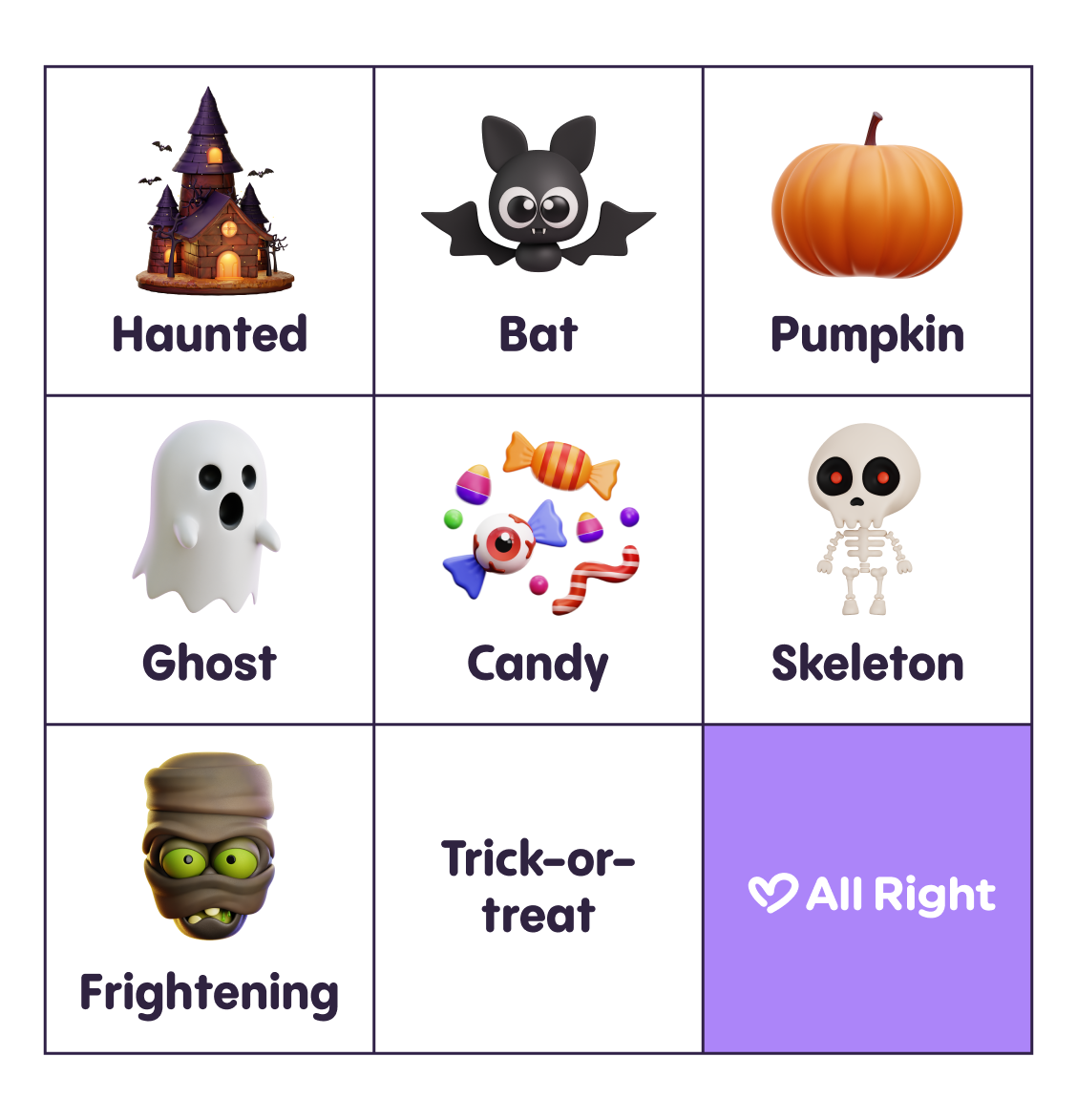
Create bingo cards with Halloween vocabulary words. Call out definitions, and students mark the corresponding word on their cards.
Bingo Card 1:
Bingo Card 2:
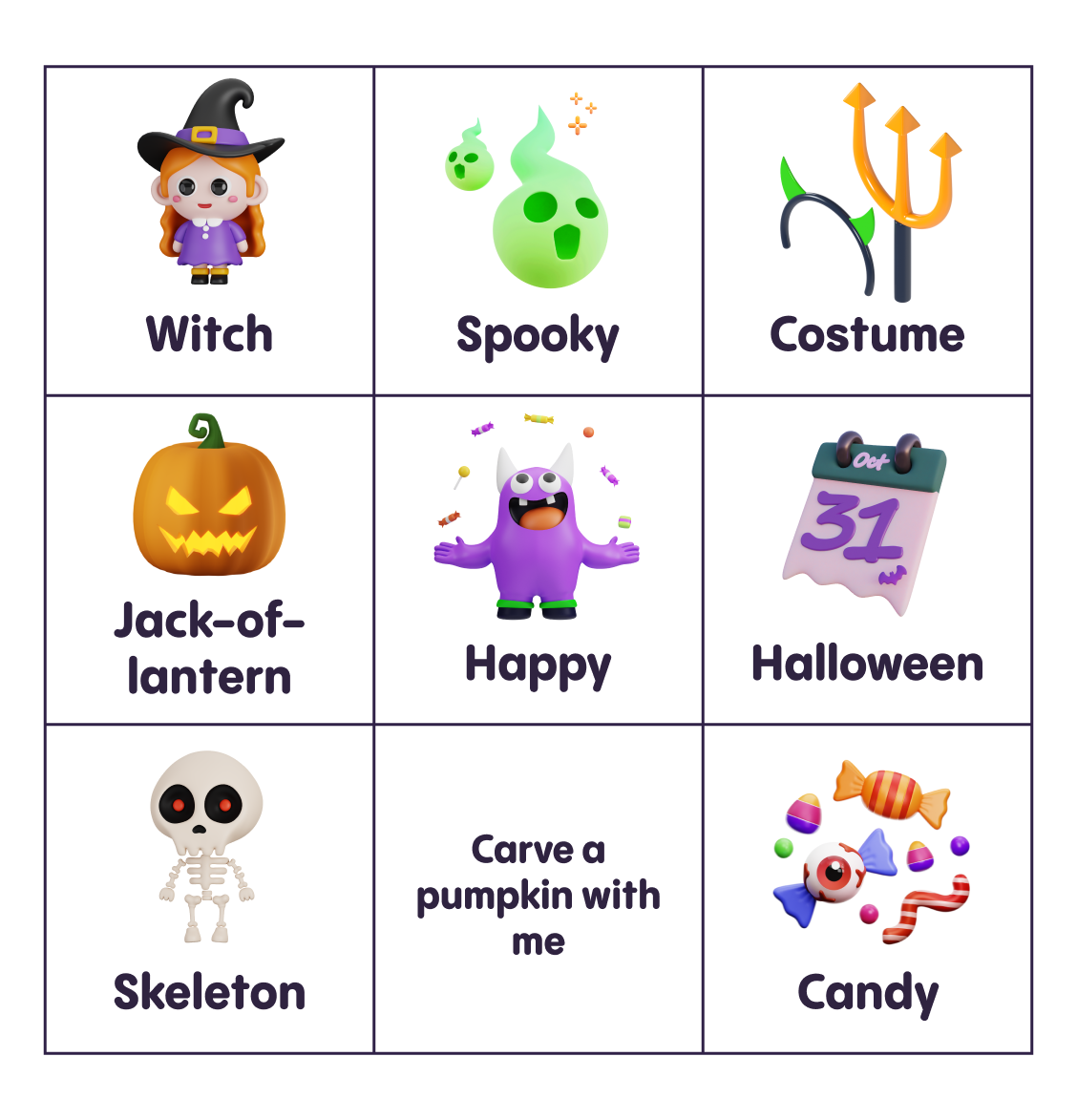
Bingo Card 3:
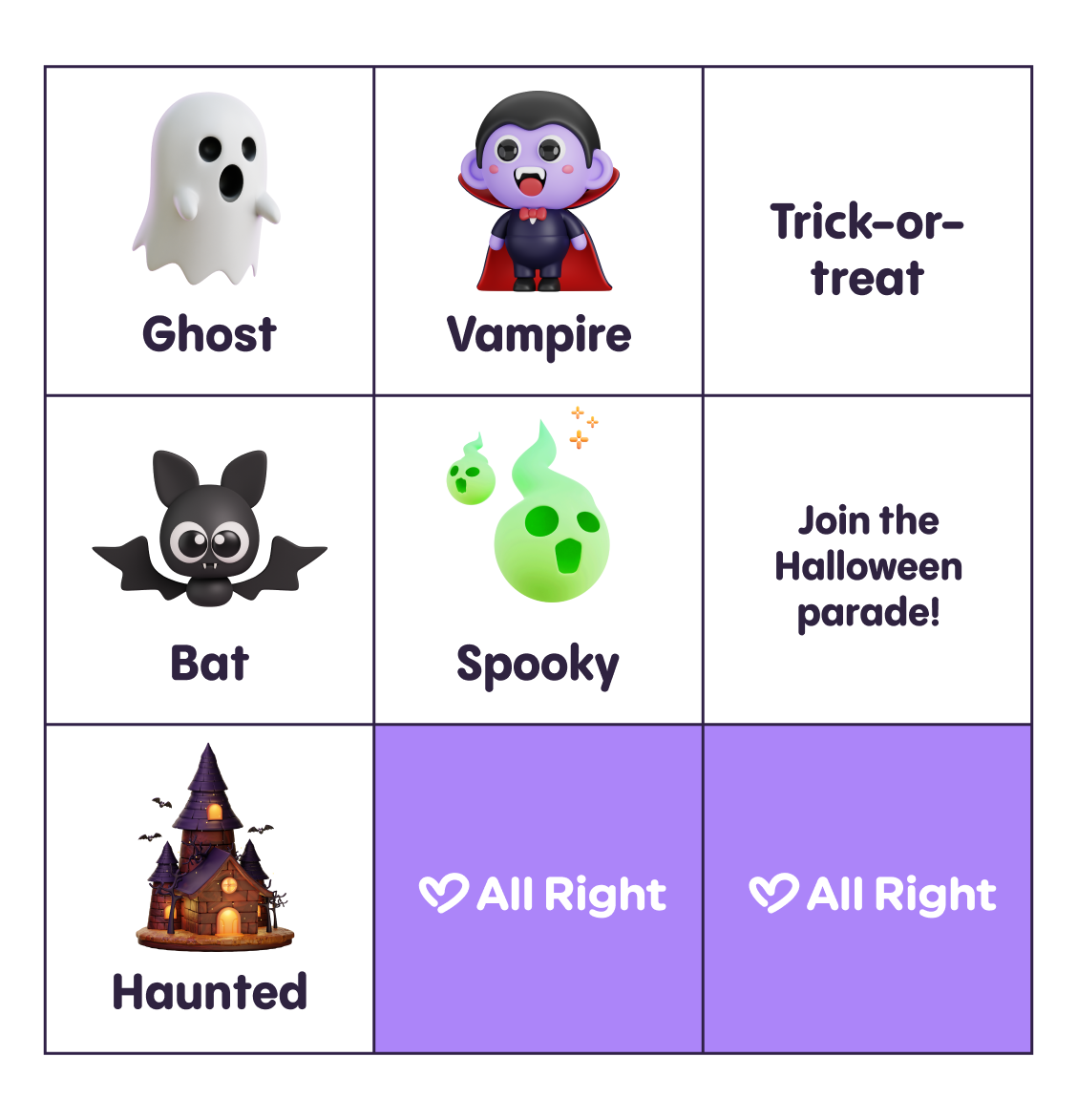
For each round of the game, the teacher can call out a definition or a phrase, and students mark the corresponding word on their Bingo cards.
For example:
- Teacher: "A flying mammal, often associated with Halloween."
- Students would then look for the word "Bat" on their bingo cards and mark it if present.
The game continues with the teacher calling out definitions or phrases, and students marking the matching words on their cards. The first student to complete a row (horizontally, vertically, or diagonally) shouts "Bingo!" and is declared the winner for that round.
This activity makes learning Halloween vocabulary enjoyable and interactive for ESL learners, encouraging them to actively listen, identify, and recall the correct words.
Halloween Charades:
Write Halloween vocabulary on slips of paper. Students take turns acting out the word without speaking, and classmates guess the word.
Here are some examples of Halloween-related words and phrases that can be used in Halloween Charades:
| Word | Action |
| Witch | Pretend to stir a cauldron or fly on a broomstick. |
| Pumpkin | Mimic carving a pumpkin or holding a large pumpkin. |
| Vampire | Show fangs and pretend to bite someone's neck. |
| Trick or treat | Pretend to knock on a door and say "Trick or treat" while holding out a pretend candy bag. |
| Carve a pumpkin with me | Demonstrate carving a pumpkin and motion to invite someone to join. |
| Bat | Act like a bat flying in the air or hanging upside down. |
| Skeleton | Pretend to assemble and move like a skeleton. |
| Haunted | Act frightened, looking around as if in a haunted place. |
| Join the Halloween parade | March in place and wave to an imaginary parade while inviting others to join. |
| Candy | Pretend to unwrap and eat candy. |
| Happy Halloween! | Mimic a happy, excited expression, and gesture as if spreading cheer. |
In the game, one person acts out a word or phrase without speaking, while the others guess. The person who guesses correctly then takes a turn to act out a word or phrase. It's a great way to enhance vocabulary and have a blast during Halloween-themed language activities!

Role-Playing Trick-or-Treating:
Pair students and have them practice trick-or-treating dialogues using the phrases provided, taking turns being the homeowner and the trick-or-treater.
Here are examples of how the phrases and vocabulary can be used in this role-play:
Scenario: Two Students Role-Playing Trick-or-Treating
Student 1: Trick-or-Treater
Student 2: Homeowner
Dialogue 1: Greeting and Asking for Candy
- Student 1 (Trick-or-Treater): "Happy Halloween!"
- Student 2 (Homeowner): "Happy Halloween! What's your costume?"
- Student 1: "I'm a ghost. Can I have some candy, please?"
- Student 2: "Of course! Here you go. Have a spooktacular time!"
Dialogue 2: Greeting and Playing Along
- Student 1: "Trick or treat!"
- Student 2: "Trick or treat! What a spooky costume! Here's your treat."
- Student 1: "Thank you! Watch out for ghosts!"
Dialogue 3: Complimenting the Costume
- Student 1: "Trick or treat!"
- Student 2: "Trick or treat! Wow, you look frightening! What's your costume?"
- Student 1: "I'm a vampire. Thank you for the candy!"
- Student 2: "You're welcome! Have a spooky Halloween!"
Dialogue 4: Inviting to Join Halloween Parade
- Student 1: "Trick or treat!"
- Student 2: "Trick or treat! Oh, what a creative costume! Are you going to the Halloween parade?"
- Student 1: "Yes, I am! Join the Halloween parade too!"
- Student 2: "Sounds like fun! Maybe I will."
Through role-playing, ESL learners can practice greeting, asking for treats, expressing gratitude, and engaging in playful Halloween interactions. It encourages them to use the Halloween vocabulary and phrases in a realistic context, enhancing their language skills and boosting their confidence in using English during this festive occasion.
Halloween Storytelling:
Encourage students to create short stories using the vocabulary and phrases. They can read their spooky stories aloud to the class, incorporating the learned language.
Here are examples of how the vocabulary and phrases can be incorporated into a Halloween story:
Title: "The Haunted Mansion"
Once upon a time, on a chilly Halloween night, a group of friends gathered at the edge of town. The rumors of a haunted mansion had intrigued them, and they decided to explore the mysterious house.
As they approached the mansion, they noticed a dim light flickering inside, creating eerie shadows. The wind howled, and the trees whispered tales of ghosts and hidden treasures. The house had an old pumpkin on the porch, carved into a sinister face - a classic jack-o'-lantern.
With hearts racing, they mustered the courage to knock on the door, saying "Trick or treat!" No one answered, but the door creaked open slowly. They bravely entered, stepping into a dark hallway. Suddenly, they heard a voice whispering, "Welcome to my domain."
Frightened but curious, they followed the voice to a room filled with strange objects - an old skeleton, dusty books, and peculiar potions. They noticed a peculiar witch hat hanging on the wall, seemingly enchanted. One friend said, "Let's try it on and see what happens."
As the hat was placed on the head, a magical transformation occurred. They found themselves in a world of sorcery and spooky creatures. They encountered a bat that guided them through a maze of challenges, each scarier than the last. The frightening experiences were both thrilling and nerve-wracking.
In the end, they reached a room where a grand party was in full swing. The ghosts they had heard about were actually friendly and loved to celebrate Halloween. The friends joined the party and danced the night away, laughing and making new friends.
As the clock struck midnight, the friends were transported back to the real world, still wearing the witch hat. The mansion was no longer haunted; instead, it was a magical place they would always remember. They left with hearts full of memories and an unforgettable Halloween adventure.
Halloween Vocabulary Flashcards
Create flashcards with Halloween vocabulary on one side and the definition or a sentence using the word on the other. Use them for vocabulary review and games.
By incorporating these Halloween vocabulary and phrases into ESL lessons, teachers can create an engaging and festive learning environment that enables students to expand their language skills while embracing the Halloween spirit. Happy teaching and happy Halloween!